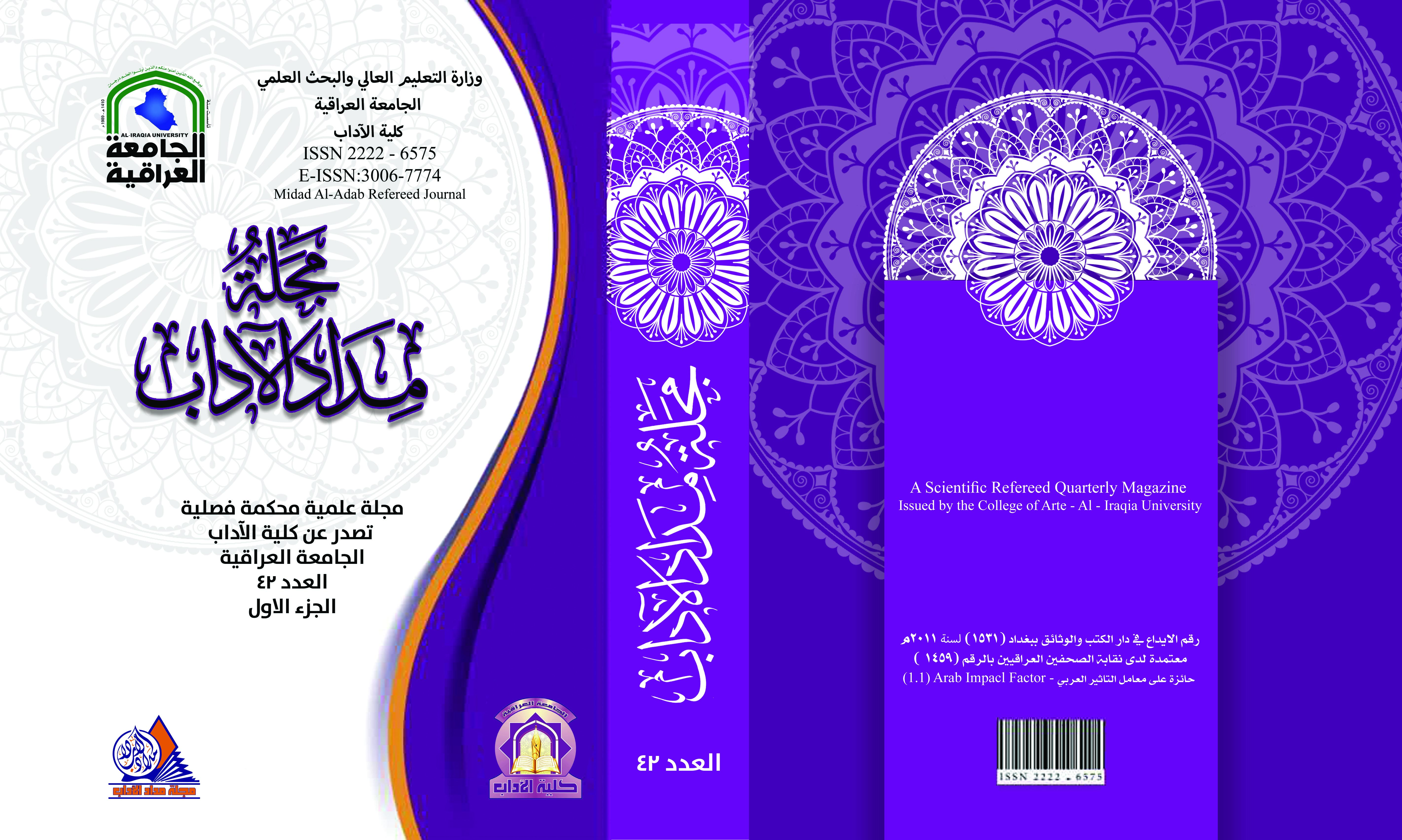
The formation and demolition of meaning: narrative and cultural systems in Al-Nafri’s positions and speeches.
DOI:
https://doi.org/10.58564/ma.v16i42.2533Keywords:
Keywords: Sufi text, al-Niffari, discourse positions, system, cultural approach.Abstract
This study aims to uncover the narrative and cultural patterns in Al-Niffari's Sufi writings, drawing on his two books, "Positions" and "Meetings." The research focuses on analyzing these patterns, whether religious or social, that form the structure of Al-Niffari's Sufi text, and how these patterns contribute to constructing and destructing meaning within the text. The problem arises from the complex nature of the Sufi text, which combines subjective spiritual experience with symbolic language. The research asks: How do the apparent and implicit cultural patterns operate in Al-Niffari's discourse? What is their role in shaping his Sufi vision and in constructing the text narratively and semantically? The study adopted a cultural approach that combines internal textual analysis tools—rhetoric, narrative, and semantics—with external analysis linked to the cultural and Sufi context that produced the text, while leveraging the potential of the structural compositional approach in linking the internal structure to the external. The text reveals two complementary systems: an apparent system based on Arab-Islamic culture and direct religious concepts, and an implicit system that forms the deep structure of the text and expresses the existential Sufi experience that transcends familiar language and is based on gesture, symbolism, and the continuous demolition of traditional concepts. The study concludes that al-Niffari's discourse, through this dual mechanism (formation/demolition), constitutes an alternative Sufi discourse that challenges traditional dualities and establishes a unique existential vision. The study also reveals how these systems operate in shaping an alternative Sufi vision.
Downloads
Published
Issue
Section
License

This work is licensed under a Creative Commons Attribution-NonCommercial-NoDerivatives 4.0 International License.